

Always Improving
Few furniture designs reveal their own evolution as clearly as the Eames shell chair.
At a glance, the differences can seem minor. The silhouette remains familiar. The function remains the same. Yet a closer look reveals decades of refinement. Bases change. Colors evolve. Fiberglass shifts in character. Construction details appear, disappear, and return in new forms.
This is one of the qualities that makes shell chairs so compelling to collect.
Charles and Ray Eames never regarded the shell as a finished object. As materials, manufacturing techniques, and production methods developed, the chair developed alongside them. The shell was continually adjusted, refined, and improved. What is often understood as a single design is actually a long sequence of related designs connected by a common idea.
The progression from an early X-base shell to a later H-base example illustrates this particularly well. Both are unmistakably Eames chairs, yet they reflect different moments in the life of the design. Each reveals a distinct set of priorities, manufacturing realities, and solutions.
For collectors, these differences are not simply technical details. They are evidence. Every generation leaves clues about how the chair was made, what problems were being solved, and how Charles and Ray Eames thought about improvement.
This is why shell chairs reward close study. The category is familiar enough to feel approachable, yet complex enough to sustain years of collecting. The more examples one encounters, the more distinctions become visible.
What begins as a chair gradually becomes something else: a record of continual refinement, preserved in fiberglass.
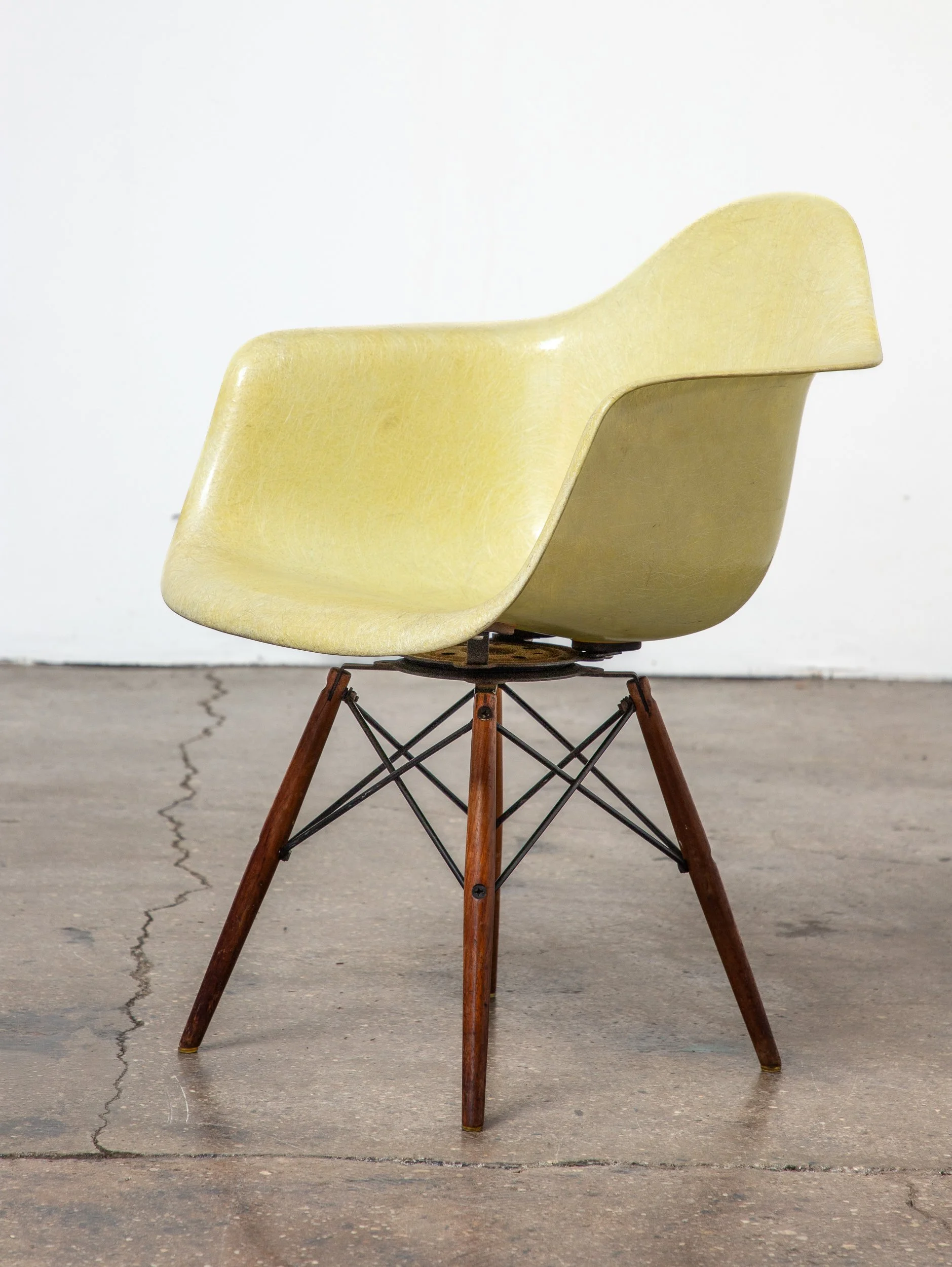
A first edition Eames fiberglass chair with rope-edge, large glides and original swivel base.
